Wednesday, March 16, 2011

Early Bloomers

Although spring doesn’t officially start for another week, a stroll in the garden will tell you otherwise.  With the snow finally melted and the soil beginning to warm, the garden is once again showing signs of life.  Spring-flowering bulbs are beginning to poke through the leaf litter, and tree flower buds are beginning to swell.  Many migrating birds are back and can be easily seen perched on bare tree branches.   All these signs are telling us that spring has arrived.
Photo: Witchhazels flowering on March 9th, Hofstra University, Hempstead

But for me, the unofficial start to spring begins with the blooming of the Witchhazels (Hamamelis spp.).  Almost a month before the Flowering Cherries or Forsythia come into bloom, the Witchhazel proudly displays its golden-yellow flowers.  Unique clusters of tendril-like petals hug the thin branches of this large, upright, deciduous shrub.  The sunny yellow flowers displayed against a backdrop of drab grays and browns, remind us of the warmer days soon to come.  But If the Witchhazel had waited another month until the other spring flowering trees were in bloom, probably not many people would be paying attention to the odd-looking, funky flowers.  But the Witchhazel is smart – by flowering before any other tree, the Witchhazel can monopolize a small number of pollinators, and monopolize the hearts of a large number of gardeners.    
Photo: The unique flowers of Witchhazel

Most Witchhazels planted these days are cultivars of the hybrid Witchhazel (Hamamelis x intermedia), which is a cross between the Chinese (H. mollis) and Japanese Witchhazels (H. japonica).  The hybrid Witchhazel is a fairly vigorous large, multi-stemmed shrub that grows up to 20 feet tall, with an upright, spreading habit.  One of the top cultivars for yellow flowers is ‘Arnold Promise.’  Other varieties have been developed with copper-colored or red flowers, including ‘Jelena’ and ‘Rubin.’  Witchhazel can be grown in full sun or partial shade, and prefers moist, fertile, acidic soil.  The leaves of Witchhazel have wavy edges, and many plants have a slightly blue or gray tinge to the foliage.  Depending on the cultivar, fall color can be a spectacular display of bright yellow, scarlet, or orange. 
Photo: 'Arnold Promise' is a great yellow-flowering cultivar of Hamamelis x intermedia, Riverhead

But if you happen to spot yellow flowers amidst all this fall color, your eyes are not deceiving you – our native Common Witchhazel (Hamamelis virginiana) actually flowers in late fall rather than late winter.  Common Witchhazel is native to most of the eastern U.S. where it forms an understory large shrub or small tree in deciduous forests.  Common Witchhazel also makes an excellent landscape plant, perfect for the shrub border, native gardens, or naturalized areas.    
Hamamelis is a genus of plants that loves to flower when few others are doing so.  If you would like to extend the season in your garden, consider planting a Witchhazel.  No other plant will tell you that spring is unofficially here!

Saturday, March 5, 2011

The Kids Aren't Alright

Most everyone is well aware of the growing number of problems that plague children these days.  Childhood obesity and diabetes, depression and teen suicide, school bullying, and attention-deficit disorder are some of the heart-breaking difficulties that families face.  Today, growing-up healthy and happy seems to be more difficult than ever before.  Thanks to Richard Louv, author of Last Child in the Woods, we can now add another problem to this laundry list: “nature-deficit disorder.”  Yet we can also add a viable solution: nature.
Louv describes nature-deficit disorder as the human costs of alienation from nature that can be increasingly perceived in individuals, families, and communities.  While not a medical diagnosis, nature-deficit disorder is a term that may help explain the increasing feeling of isolation from the physical and spiritual world, and its negative results.  In his book, Louv pleads that if we don’t want our next generation to be entrapped by physical and emotional illnesses, we have to reunite our children with nature. 
Louv emphasizes that a child’s early experiences in nature – whether that means in the backyard, the back woods, the family farm or garden, or the overgrown, empty lot – are formative and essential.  Among other things, nature will teach a child to utilize all the senses, manage risks, and learn the limitations of his or her body, while nurturing creativity, and most importantly, inspiring awe.  Louv makes a case that childhood experiences in nature were influential in the creative development of some of the world’s greatest leaders.  Louv recounts the stories of little Thomas Edison sitting on goose eggs to make them hatch, young Eleanor Roosevelt disappearing into the woods to write short stories about butterflies, and the small John Muir chasing down seagulls on the beach. 
Photo: As a kid, I loved climbing trees like this giant European Beech (Fagus sylvatica). 1995

Which got me to thinking, can our childhood nature experiences really be absolutely essential to how and who we grow up to be?  At least for me, I think the answer is pretty straightforward.  Thankfully I had the type of parents who encouraged outdoor play and exploration – a father who collected frogs and turtles and took me and my sisters camping every year, and a mother who taught us to be observant and creative. 
Louv reports that one of the main stumbling blocks to reuniting children with nature is the vast number of distractions keeping kids inside.  In his book, he recounts that when one fourth-grader in San Diego was questioned, the child replied, “I like to play indoors better ‘cause that’s where all the electrical outlets are.”  How true.  Growing up in an affluent suburb in the late ‘80s and early ‘90s, my family was one of the only households that didn’t have Nintendo or Sega Genesis.   My sisters and I were only allowed to play video games at friends’ houses.  At a friend’s house, I’d first be so excited to play Super Mario Brothers for the novelty of it, but I would always get bored quickly.  Without much video game practice, of course I’d die right away and would have to wait forever for it to be my turn again.  TV is another huge distraction that was minimized in my childhood.  Growing up, I was only allowed to watch TV after 7pm, if I finished my homework.  No “Saved by the Bell” or Saturday morning cartoons for me.  Instead, I’d end up going down to the park, or riding my bike, or playing horses in the backyard.  Although my boyfriend is continually mocks me about all the ‘80s pop culture I missed, I feel I’m the better for it.  Looking back, it is amazing how much my parents resisted the technology craze.  Today’s parents must have it even harder as more and more electronic distractions are keeping kids inside.     
I remember often playing in our backyard.  The grass would get torn up from all the running around on all fours me and my sisters would do while playing horses, or dogs, or cats.  I remember picking blueberries, raspberries, and cherries in our backyard, still wet from morning dew.  I remember counting the goldfish in our dinky pond, not really minding that they kept getting eaten by passing herons, so long as I could get a glimpse of the snowy white shorebirds.  I remember growing parsley and cucumbers and being proud to actually eat vegetables.  I remember cleaning-out a narrow, hidden section of our backyard sandwiched between two neighbors’ fences and declaring it our clubhouse.  I remember sweltering in the summer sun pulling out never-ending weeds from the driveway by hand as one of my chores.  I remember trying to not make eye contact with the neighbors walking by who looked on amused yet curious that a 14 year old girl was mowing the lawn instead of the landscapers.  I remember climbing our Norway Maple tree in the front yard and being silent and surprised that no one walking by ever looked up to see me.  I remember climbing an enormous beech tree once at a family picnic, and feeling somewhat smug that the arboretum attendant looked absolutely shocked at how high I had climbed when he told me to get down from there immediately.   I’d bet that it’s not a coincidence that I became an arborist or an extension agent.
Photo: Today, nature is still an important aspect of my life. Mongaup Pond, the Catskills, 2010

Yesterday I was fortunate to hear a lecture by Susan Lacerte, Executive Director of the Queens Botanical Garden in Flushing.  She described the process of redesigning their offices and garden to create a sustainable gray water and storm water catchment and recycling system.  As a result of their efforts, the Queens Botanical Garden was one of the first places in the country to achieve platinum certification from the U.S. Green Building Council’s Leadership in Energy and Environmental Design (LEED™) Green Building Rating System, the highest possible certification.  Her inspiration for using water as a central feature in the garden came from her childhood – the memory of camping with her family.  Huddled inside the tent during a rainstorm, she vividly remembers hearing raindrops hit the top of her tent and watching them gently roll down the sides and off, to splat on the ground and make mud puddles.  From mud puddle memories LEED™ platinum certification is born.  Perhaps Richard Louv is really on to something…  Nature for both kids and adults may be more important for emotional, physical, and spiritual well-being than we’ve ever realized.  I think it’s time we all took a step outside. 

 Louv, Richard. 2008. Last Child in the Woods: Saving Our Children from Nature-Deficit Disorder. Algonquin Books: Chapel Hill, NC.


Sunday, February 27, 2011

Go Green with Green Roofs

There are both small steps and big steps you can take to go green and show your commitment to the environment.  A small green step would be using canvas shopping bags, while a big green step would be purchasing a super fuel-efficient hybrid or electric car.  As gas prices climb higher and higher, buying that fuel-efficient car seems more and more like a big green step people are willing to take.  But if you already have a hybrid car, there are other big steps you can take to continue to “green-ify” your life.  Installing a green roof is one of these.  Green roofs offer a fantastic way to reduce your carbon footprint, and offer a space for you to experience your own little patch of Eden. 
Photo: Green roofs can provide both environmental benefits and beauty. Chelsea, New York City 

A green roof is a highly engineered extension of the roofing system that uses plant life to meet functional and aesthetic needs.  Green roofs are quite diverse and may consist of a thin mat of low-lying vegetation, or a highly diverse planting of perennials, shrubs, and even trees.  How your green roof is designed will depend on how much you are willing to monetarily invest initially, how much soil and weight your existing roof can support, and how much use and access you will need to the finished green roof.  The best green roof plants are drought- and cold-tolerant, and have low nutrient requirements and a shallow root system.  Plants that are evergreen are also favored because they are able to insulate a home year-round.  Many different types of sedums have performed remarkably well as green roof plants.    
Photo: Sedums like Goldmoss Stonecrop (Sedum acre) make excellent green roof plants

Like traditional gardens, green roofs offer both environmental benefits and beauty.  But green roofs will also save you money.  By insulating buildings, green roofs provide improved energy efficiency.  It is estimated that green roofs provide an 87% reduction in heat gain in the summer, and a 37% reduction in heat loss in the winter.*  Also, the lifespan of a green roof is 2-3 times that of a traditional roof, leading to lower roof maintenance and replacement costs.  Green roofs also help reduce stormwater runoff by absorbing, retaining, and cleaning rainwater.  Investments in green roofs and other green infrastructure, are extremely important for municipalities including New York City that have reached the functional limits of existing sewers and other grey infrastructure.
Although virtually unknown in the United States until a few years ago, green roofs have actually been in use for hundreds of years.  In Scandinavia, sod or turf roofs have been used for centuries in traditional home construction.    The first “modern” green roof dates back to 1914 in Zurich, Germany.  While green roofs are now fairly common in Europe, there is much potential for expansion in the U.S.  Many cities have recognized the environmental benefits provided by green roofs, and are now offering incentives to homeowners and businesses for green roof installation.  If you live in New York City, you’re in luck.  A tax abatement equal to $4.50 per square foot of green roof space up to $100,000 is now being offered.  (For more info, check out http://www.nyc.gov/html/dob/html/forms/forms_tax_abatement.shtml)  Make sure to obtain any required permits that comply with zoning and building codes before beginning green roof construction.
Photo: Queens Botanical Garden features a green roof and a stormwater catchment system that recycles water back into the gardens. Flushing, Queens

If you are looking for a little green roof inspiration, a great place to check out is the Queens Botanical Garden in Flushing (www.queensbotanical.org).   Their new Visitor & Administration Building features a walkable, gently-sloping green roof.  The 3,000 square-foot roof is planted primarily with drought-tolerant native perennials.  Stormwater that is not utilized by the green roof is recycled back into the gardens through a stormwater catchment pool. 
Whether you decide to install a green roof on your home or not, make sure all your steps are green ones!


*Source: A Temperature and Seasonal Energy Analysis of Green, White, and Black Roofs. Gaffin, S.R., Rosenzweig, C, et.al. Center for Climate System Research, Columbia University/Con Edison, April 2010.

Friday, February 18, 2011

Breakin' the Law - Illegal Plants

When I talk about illegal plants on Long Island, I’m NOT talking about a certain one used for “medicinal” purposes.  What I am talking about are invasive plants.  Two years ago, it actually became illegal to sell, transport, distribute, and propagate dozens of invasive plants in both Nassau and Suffolk Counties.   Invasive plants are not just harmless little weeds and dandelions - invasive plants are the thugs of the plant world.  They can cause considerable damage to natural habitats by invading ecosystems which they are not native to, and displacing the native flora.  The population of native plants is then reduced or even wiped out in some cases.  This in turn affects wildlife and other species which may be dependent upon the local flora for food or habitat.  The introduction and spread of invasive species is the second leading cause of global biodiversity loss. (Habitat loss is the number one leading cause.)  About 42% of species listed on the U.S. Threatened or Endangered Species Lists are at risk primarily due to competition or predation from invasive species.* 
Photo:  The invasive vine, Sweetautumn Clematis (Clematis terniflora), engulfing vegetation along the Peconic River in Riverhead

You may be asking, so how do these tough non-native plants overtake our “wimpy” native plants?  The answer can be explained by evolution.  Because a non-native plant did not evolve with the local species, it may have few or no herbivores or pests that like to eat it in its new location.  It also may have developed superior ways to acquire essential resources such as water or sunlight compared to the local species, which makes it a better competitor.  Like real thugs, these invasive plants also bring bigger and badder gats to the gunfight.  Certain characteristics allow a plant to adapt quickly to a new environment, thrive, and spread.  Most invasive plants possess one or more of these characteristics which include, abundant reproduction; rapid growth rate; short generation time; ability to occupy many different habitats; ability to adapt to changing environments; effective seed dispersal; long-lived seeds; and being poisonous or allergenic to other organisms.
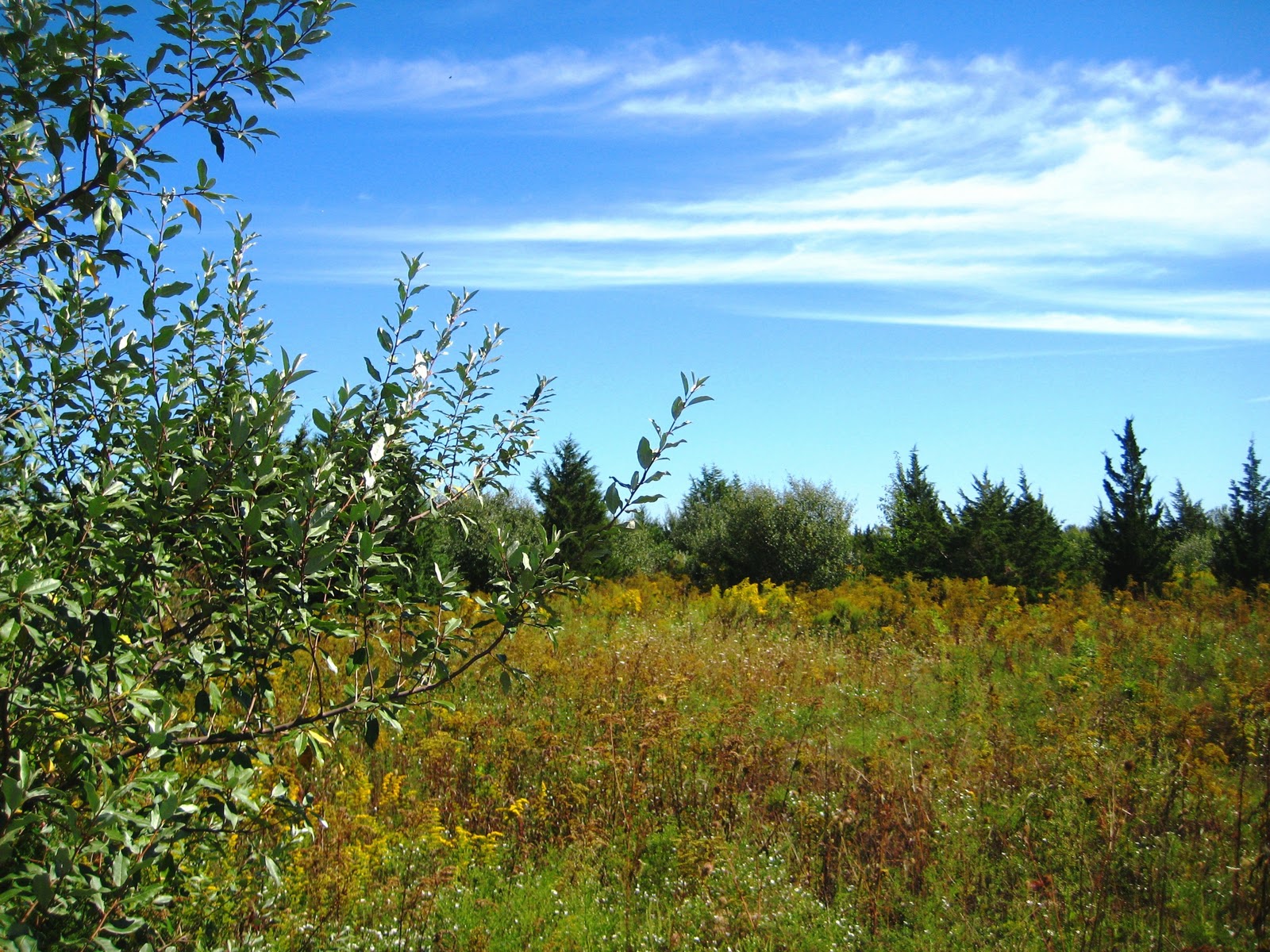
Photo:  The invasive shrub, Autumn-Olive (Elaeagnus umbellata), colonizing an old field in Calverton

So what might look like some nice greenery, might actually be the battlegrounds of ecological warfare, where rampant, Oriental Bittersweet vines (Celastrus orbiculatus) are engulfing full-grown trees, Phragmites reeds (Phragmites australis ssp. australis) are choking out waterways, and Mugwort (Artemesia vulgaris) is invading our gardens.  The cost of controlling invasive plants is mind-boggling!  In 2005, the annual cost to the US economy for invasive herbaceous weeds (not including trees and shrubs) was estimated to be $27 billion in crop systems, $6 billion in pastures and rangeland, $1 billion in golf courses, and $500 million in residential yards and gardens!*
 Many people are working hard to control invasive plants, including park and wildlife refuge managers, botanists, environmental engineers, landscapers, and now even Long Island legislators.  But even the world’s top biologists and ecologists cannot predict what the outcome will be of this ecological war – will most species of native plants perish in the wake of invasive plants?  Will native and invasive plants establish an equilibrium and co-exist?  Will invasive plants die-out in a couple decades or centuries as the native flora and fauna evolve with them? 
Although the answers to these questions remain unknown, “thinking globally and acting locally” rings true in this situation.  Being concerned about global biodiversity can spur us to action in our own backyards and gardens.  You can start by learning how to correctly identify invasive plants and remove them from your yard.  Definitely make sure to not buy illegal invasive plants that are now banned on Long Island.  You may want to consider growing or planting species native to Long Island or the Northeast.  Native plants are a wonderful way to preserve local biodiversity and attract birds and wildlife to your backyard.  However, be sure to remember that there are also many non-native, NON-invasive ornamental plants that also make great selections, especially if you are planting in a tough location. 
For the list of illegal plants on Long Island, visit http://ccesuffolk.org/nursery-and-landscape-current-projects/.  This page will also give you suggestions for alternatives to long-standing ornamental plants that have been found to be invasive, like Norway Maple (Acer platanoides) and Japanese Barberry (Berberis thunbergii).  By each of us doing our part, maybe we’ll eventually be able to win the weeds war!
Photo: The invasive ornamental shrub, Japanese Barberry (Berberis thunbergii), can produce up to 9,900 seeds per plant, depending on cultivar

*Source:  Pimentel, D., R. Zuniga, and D. Morrison. 2005. Update on the environmental and economic costs associated with alien-invasive species in the United States. Ecological Economics 52: 273 – 288.

Saturday, February 12, 2011

Trees for All Seasons

Everyone can appreciate a lovely, ornamental tree covered in springtime blossoms.  In April, the pears, plums, cherries, and magnolias don a canopy of delicate white and pink flowers, ushering in the new spring.  These charming little trees look absolutely stunning at this time of year.  But only after a few short days, the blossoms begin to wither, turn a mushy brown, and give way to new leaves.  With their showy flowers gone, these trees quickly fade into the nondescript, surrounding landscape.
 If you’re a person like me, who wants more from your garden than two weeks of flowers followed by BLAH, let me recommend two rather unusual ornamental trees – Paperbark Maple (Acer griseum) and Japanese Stewartia (Stewartia pseudocamellia).  These two trees are what you would call four-season plants, which are hard to come by.  Both Paperbark Maple and Japanese Stewartia add remarkable beauty to the landscape in every season, even winter. 
Paperbark Maple is a small, ornamental maple tree that grows up to 20-30 feet tall.  Originally from China, it grows slowly and is hardy in zone 5 to 7, sometimes 8.  Like its name suggests, Paperbark Maple has unique bark that exfoliates like the bark of a Paper Birch, in long, curling strips.  The bark begins exfoliating at a young age.  But the color of the bark is even more remarkable.  No other tree that I know of has such vibrant, deep, rust-colored bark.  Paperbark Maple is especially head-turning in winter when the orange-spice bark prominently stands out against white snow. 
Photo: Paperbark Maple (Acer griseum) at Planting Fields Arboretum, Oyster Bay

Paperbark Maple is adaptable to many different soil types and soil pH, although it performs best in well-drained, moist soil.  Paperbark Maple can be grown in partial shade or full sun.  This maple makes an excellent specimen tree and is a beautiful and stately addition to any home landscape.
Japanese Stewartia is also a small, ornamental tree that grows up to 20-40 feet tall.  If you absolutely must have a tree that flowers, Japanese Stewartia is a great choice.   
Photo: Summer flowers of Japanese Stewartia (Stewartia pseudocamellia)

Long after all the other trees have finished flowering, the 2-3 inch wide creamy white flowers of Japanese Stewartia open in the middle of the summer in July.  A couple months later, beautiful fall foliage displays scarlet, yellow, and wine-colored hues.  In the winter, plated exfoliating bark is its main attribute.  Hushed gray, brown, and pale orange bring interest to the winter landscape.  Japanese Stewartia is hardy in zone 5, sometimes 4, to 7.  This spectacular tree is best grown in moist, fertile, acidic soils in full sun. 
Photo: Exfoliating bark of Japanese Stewartia (Stewartia pseudocamellia) at Bayard Cutting Arboretum, Great River

Not surprisingly, Paperbark Maple and Japanese Stewartia are both Long Island Gold Medal Plant winners.  You may have to visit a few more nurseries to find these two trees, and you probably will have to pay more for them than the run-of-the-mill flowering pears, plums, and cherries, but they will certainly be worth the extra effort, especially in winter.