Wednesday, January 15, 2014
Welcome!
Welcome to Long Island's Garden Girl! A personal blog where I posted nearly 52 nature-based essays over the course of a year. The posts are centered on topics central to successful gardening in the heart of New York's suburbs. Although I am no longer adding to this blog, I have left it up since many posts have proven to be quite popular over the years. I hope you enjoy perusing this site, and learn how to cultivate your own inner green thumb!
Happy Gardening!
Alexis Alvey


Wednesday, November 30, 2011
Don't Pave Paradise
I remember my hands trembling inside my gloves as I
attempted to hold my hand-made sign steady.
I couldn’t decide if it was the typical frigid temperatures of November
in Ithaca, NY that made me shiver, or something else. Huddled under a thick gray sky, a crowd of
nearly fifty Cornell students and Ithaca residents had gathered that morning. Side by side, we stood in the backyard of a
historic, yet deteriorating mansion that housed Cornell University students. Most of us came prepared with hats and scarves
and thick coats, and pots and pans and drums and signs, as well as determination
and youthful optimism, to help us get through the long, cold day.


Cornell administrators clearly failed with Redbud Woods. Now, six years later, student protestors have long since graduated, and the enormous controversy has been relegated to a mere plaque. One time I asked my sister who is now a student at Cornell, “Did you ever know about Redbud Woods?” “Oh, yeah, I think I heard about that once,” was her reply. I guess it is true that you don’t know what you’ve got till it’s gone… Thankfully, since then, Cornell University has created and met real goals of environmental protection and sustainability both on and off campus.
Now that I’ve told the story of Redbud Woods, I hope you can understand my dismay upon learning that a similar story may be playing out at Virginia Tech where I did my graduate work. Like Cornell, I have fond memories of Virginia Tech – jogging along the Huckleberry Trail, watching the geese float by in the duck pond, reading a book beneath the trees on the Drillfield… It is these types of experiences in natural areas that create a sense of place and strengthen our connection to the land, our campus, and our community.
Photo: Student reading on Virginia Tech's Drillfield, Blacksburg, VA

Unfortunately, one such natural area on Virginia Tech’s campus is at risk of being turned into an indoor practice field. Tucked behind the football stadium is fifteen acres of old growth forest known as Stadium Woods. Surrounded by campus buildings and fenced-off pastures, it is amazing that one of the last remaining vestiges of old growth forest remains right on Virginia Tech’s campus. White oaks over 300 years old tower above native flowering dogwoods below. Stadium Woods is a unique habitat and a vital teaching area for the forestry program. As a Virginia Tech alumna, it is my opinion that not one oak should fall in the name of football.
I hope that the story of Redbud Woods lives on and is not repeated at Virginia Tech. Let it serve as an allegory and a warning… a warning that we all need to recognize the value of our woods, our forests, our wetlands, our beaches, and all our other natural lands BEFORE the threat of development looms, not after. We need to erect commemorative plaques and signs communicating the value and history of a place BEFORE the bulldozers come, not after. We need to teach our children what a redbud tree or a 300 year old white oak looks like before they are gone. In essence, what we need to do is to shift our focus. We need to stop thinking of our urban woodlands as undeveloped or abandoned lots and wastelands. Instead, we need to think of them as existing or potential parks, gardens, and niches of nature that we all need and value in an ever increasingly urbanized world. Until then, they’ll keep paving paradise and putting up parking lots.
Please consider signing the petition to protect Virginia Tech’s Stadium Woods:
https://sites.google.com/site/stadiumwoodsvt/
Photo: Cornell University 660 student residents and Redbud Woods supporters, Oct. 2004

Our faces were turned upward, towards a gnarled oak tree that
rose before us. Fifty feet up in its branches
was my forestry lab partner, Liz, our hero of the day. Like us, she had come prepared as well – a wide
piece of lumber had been nestled among the limbs on which she stood, like the
beginnings of a tree house. A climbing
harness and ropes were laid out over the branches. One of these ropes was attached to a metal
bucket which carried cold sandwiches up the tree to Liz throughout the day.
I remember looking down at my sign which read, “Don’t Pave
Paradise,” a line which referenced that quintessential environmentalist song Big Yellow Taxi by Joni Mitchell from 1970. I however, being a young and inexperienced activist,
thought that the band Counting Crows had written the song when they did a cover
of it thirty years later. Regardless of
who sang the line, “They paved paradise
and put up a parking lot,” it was perfect for our situation – the year was
2004 and Cornell University administrators planned to pave Redbud Woods, a
small, historic patch of woodland, and put up a parking lot for students.
Photo: View of Redbud Woods from the back porch of 660 Stewart Ave., circa Nov. 2004, Ithaca

Although covering only about two acres, Redbud Woods was no
ordinary patch of trees – the mansion at 660 Stewart Avenue and its wooded
backyard was the original family estate of Robert H. Treman, a banker and
Cornell alumnus who helped preserve the area’s breathtaking gorges. Ithaca’s Treman State Park is named for this
historic figure. Treman planned for his
land to be ''left to nature as the best gardener,'' and Redbud Woods was part
of the University Hill Historic District created by the city of Ithaca. Along with thirty other students, I had the
pleasure of living at this old estate for one semester, which I considered to
be by far the best undergraduate housing on campus. In the mid-spring, I remember looking out the
window of my dorm room inside the crumbling mansion, and seeing small redbud
trees interspersed amongst the big oaks brightening up the woods with their warm
magenta flowers. Just beyond, were the
clear waters of Lake Cayuga.
Photo: Eastern Redbud (Cercis canadensis) in flower

Standing outside that November day, neither I nor the other
students knew what we were up against.
The tree sit-in was just the first of many protests. For eight hours, Liz calmly sat in the oak
tree, until 5pm when Cornell University police finally arrested her, charging her
on five accounts, including reckless endangerment, disorderly conduct, and
resisting arrest. What followed was a
nearly year-long battle to save Redbud Woods.
Cornell students, Ithaca College students, Cornell faculty, Ithaca
residents, Ithaca historical society members, and even the former mayor of
Ithaca valiantly fought for Redbud Woods.
There were appeals to Cornell administration and the local landmarks
preservation council. There were three New York Times articles and dozens of
local and campus news articles. There
was a constant occupation of Redbud Woods by protestors. There was even a six hour student lock-in at the
Cornell University president’s office. With
all the efforts going on, you would have thought northern spotted owls were living
in Redbud Woods. But after all that, at
the end of July 2005, protestors had no other option but to watch in dismay as
bright yellow bulldozers plowed down Redbud Woods. A 176 car parking lot was carved onto the
hillside where redbuds and Robert Treman had once lived. The Cornell president at the time called the
paving of Redbud Woods a “compromise” since the new parking lot was designed to
be “sustainable.”
As an employee of Cornell Cooperative Extension, I’ve had
the pleasure of going back to Ithaca for various work-related meetings. I always like to re-walk the campus and see the
areas that I used to know so well. Ambling
through the Cornell Plantations or walking around Beebe Lake remind me of what
originally drew me to Cornell – the trees, the natural areas, the hidden gems
of beauty right on Cornell’s campus. What
I don’t visit is a “sustainable” parking lot.
If I did though, I’d come across a small plaque. Apparently, it reads:
Redbud Woods - The land
before you was once home to the extended family of Robert H. Treman, creator of
parks and protector of green spaces throughout Tompkins County. The woodland
that grew up here was inhabited for decades by diverse fauna and more than
fifty plant species, including numerous redbud trees. Redbud Woods was razed on
July 20, 2005 by the Cornell administration to build a parking lot. This plaque
has been erected by Ithaca community members in memory of this cherished
woodland. Remember the trees… Remember all who tried to save them.
Cornell administrators clearly failed with Redbud Woods. Now, six years later, student protestors have long since graduated, and the enormous controversy has been relegated to a mere plaque. One time I asked my sister who is now a student at Cornell, “Did you ever know about Redbud Woods?” “Oh, yeah, I think I heard about that once,” was her reply. I guess it is true that you don’t know what you’ve got till it’s gone… Thankfully, since then, Cornell University has created and met real goals of environmental protection and sustainability both on and off campus.
Now that I’ve told the story of Redbud Woods, I hope you can understand my dismay upon learning that a similar story may be playing out at Virginia Tech where I did my graduate work. Like Cornell, I have fond memories of Virginia Tech – jogging along the Huckleberry Trail, watching the geese float by in the duck pond, reading a book beneath the trees on the Drillfield… It is these types of experiences in natural areas that create a sense of place and strengthen our connection to the land, our campus, and our community.
Photo: Student reading on Virginia Tech's Drillfield, Blacksburg, VA

Unfortunately, one such natural area on Virginia Tech’s campus is at risk of being turned into an indoor practice field. Tucked behind the football stadium is fifteen acres of old growth forest known as Stadium Woods. Surrounded by campus buildings and fenced-off pastures, it is amazing that one of the last remaining vestiges of old growth forest remains right on Virginia Tech’s campus. White oaks over 300 years old tower above native flowering dogwoods below. Stadium Woods is a unique habitat and a vital teaching area for the forestry program. As a Virginia Tech alumna, it is my opinion that not one oak should fall in the name of football.
I hope that the story of Redbud Woods lives on and is not repeated at Virginia Tech. Let it serve as an allegory and a warning… a warning that we all need to recognize the value of our woods, our forests, our wetlands, our beaches, and all our other natural lands BEFORE the threat of development looms, not after. We need to erect commemorative plaques and signs communicating the value and history of a place BEFORE the bulldozers come, not after. We need to teach our children what a redbud tree or a 300 year old white oak looks like before they are gone. In essence, what we need to do is to shift our focus. We need to stop thinking of our urban woodlands as undeveloped or abandoned lots and wastelands. Instead, we need to think of them as existing or potential parks, gardens, and niches of nature that we all need and value in an ever increasingly urbanized world. Until then, they’ll keep paving paradise and putting up parking lots.
Please consider signing the petition to protect Virginia Tech’s Stadium Woods:
https://sites.google.com/site/stadiumwoodsvt/
Photo: Cornell University 660 student residents and Redbud Woods supporters, Oct. 2004

Monday, October 3, 2011
How Much Should I Water?
It’s such a simple question – how much should I water my plants? – and yet there is no simple answer. In the landscape, how much to water is really a “Well… it depends…” kind of scenario. It depends on how much it has rained, what the soil is like, what type of plants you have, the weather, the season…
The fact that landscape plants likely suffer more from moisture-related problems than any other problem (Harris et al. 2004)* shows us that water management in the garden is not only a complex issue, but also one that is critical to ensuring the health of our plants. We all know that having enough water is essential for plant survival and growth. But too much water can also kill or stunt a plant. Just like us, plant roots need oxygen for respiration, and if all the air space in soil is saturated with water, a plant can quickly drown. Finding the right balance between too little and too much water is challenging, but can be found through various approaches.
Photo: This Kousa Dogwood (Cornus kousa) in 2010 suffered from drought-stress after experiencing two weeks of no rain and 100+ degree temperatures. Repaving the parking lot during this time only made matters worse. Commack

Photo: This Kousa Dogwood (Cornus kousa) in 2010 suffered from drought-stress after experiencing two weeks of no rain and 100+ degree temperatures. Repaving the parking lot during this time only made matters worse. Commack

First, there’s the quick-and-dirty method. The Soil Moisture By Feel Test involves nothing more than a shovel and a willingness to get your hands dirty. Using the shovel to access the soil you want to test, take a small soil sample and roll or squeeze it into a ball in your hand. Soil moisture is just about right when you can form a ball and it crumbles when rubbed. If the soil won’t form a ball, it’s too dry to supply adequate water to plants. But if the ball will not crumble when rubbed, the soil is too wet. Unfortunately, this test is limited in its use because it won’t work for sandy soils.
Photo: Excessive rain throughout the 2011 growing season led to flooding at this nursery in Manorville. Too much water can lead to plant disease, decline, and death under the worst circumstances.

Photo: Excessive rain throughout the 2011 growing season led to flooding at this nursery in Manorville. Too much water can lead to plant disease, decline, and death under the worst circumstances.

Perhaps the most accurate way of determining how much to irrigate is to use a formula based on evapotranspiration, or the amount of water lost to evaporation by plants and soil. The leaves of plants have small openings which allow carbon dioxide to enter and water to exit by evaporation. Although about 95% of water absorbed by a plant is lost, this process, called transpiration, is important because it cools the leaves and helps with the absorption of water and nutrients by the roots and circulation of these throughout the plant. On hot sunny days with low humidity and high winds, evaoptranspiration and water loss will be the highest.
The formula method also factors in the vegetation type, microclimate, planting density, and species to arrive at a fairly accurate irrigation rate. Species can vary greatly in their water requirements and tolerance to drought and saturated soils. Be sure to consider the conditions under which a given plant evolved. Is the tree like Bald Cypress (Taxodium distichum), adapted to growing in the saturated soil of Southern swamplands? Or is the tree like Blue Atlas Cedar (Cedrus atlantica), adapted to the dry heat of the Mediterranean ? Answers to these questions will help determine the relative amount to water needed.
Photo: This Colorado Blue Spruce (Picea pungens), adapted to cool, dry areas of the west, developed Rhizosphaera Needlecast Disease (note the bare lower branches) when grown under Long Island's hot, wet, and humid growing conditions.
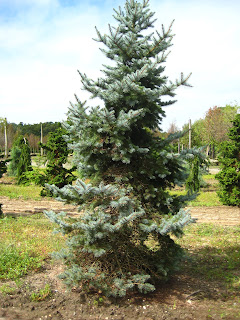
Photo: This Colorado Blue Spruce (Picea pungens), adapted to cool, dry areas of the west, developed Rhizosphaera Needlecast Disease (note the bare lower branches) when grown under Long Island's hot, wet, and humid growing conditions.

The last, and perhaps most practical, way of figuring out how much to water is to install a soil-moisture sensor. A tensiometer, which measures the force or tension that moisture is held by a soil, is a good choice for landscape settings. Each tensiometer costs about a hundred bucks and can be attached to an irrigation controller. If the soil moisture is below a certain level, the irrigation system will go off and water the plants until the desired moisture level is reached.
If you don’t like getting your hands dirty, if formulas frighten you, and if you are not inclined to purchase specialized equipment, then go by this simple rule of thumb for watering: make sure your plants get 1 – 2 inches of water (including rainfall) per week. (I bet you wish I’d said that at the beginning, right!) For recently planted trees, this equals about 15-20 gallons of water per week. During the summer months of June, July, and August it’s most important to provide supplemental water. By closely monitoring your plants, you’ll be able to get a sense of how much is the perfect amount of water.
*Harris, R.W., J.R. Clark, and N.P. Matheny. 2004. Arboriculture: Integrated Management of Landscape Trees, Shrubs, and Vines, 4th Edition. Prentice Hall: Upper Saddle River , NJ
Tuesday, September 27, 2011
Horticulture Hotspots
There are not many places on Long Island where you can find
an entire day’s worth of entertainment for less than the cost of a movie
ticket. At one of Long Island’s many
public gardens, you can spend a whole day strolling the grounds, taking
photographs, having a picnic, or touring one of the historical mansions. Long Island and the surrounding area is a Mecca
of botanical gardens and arboreta, thanks at least in part to the Island’s Gold
Coast history. We are very fortunate
that right in our own backyards there are world-class public gardens where
vibrant collections of trees, shrubs, and perennials flourish.
Photo: An allee of European Lindens (Tilia x europaea) and Eastern Hemlocks (Tsuga canadensis) creates a sweeping view of Westbury House, the former mansion of the Phipps estate at Old Westbury Gardens

Botanical gardens serve many different functions. They can be a place where people reconnect
with nature, clear their minds, and relax in a safe and beautiful greenspace. They can be a place where people learn about
plants and get inspired to try out certain plants and sustainable practices in
their own gardens. They can also be a
link to our past, reminding us how people used to live and what they valued.
Botanical gardens are also important from a scientific
standpoint. They can be a place where different
plants are studied and evaluated for their suitability for landscape use. They can be a place where global floral
biodiversity is collected and cataloged.
They can also be a great repository of genetic information from which future
conservation work can be conducted. All of
these different functions validate our continued need for public gardens,
especially in high urbanized areas like Long Island.
Whatever your reason for wanting to visit a public garden, be
sure to check out Planting Fields Arboretum if you live in Nassau or Bayard
Cutting Arboretum if you live in Suffolk.
Both are state parks and are well worth the minimal entrance fee. Located on the North Shore in Oyster Bay, Planting
Fields was the “country home” of Mr. William Robertson Coe who purchased the
estate in 1913. The park currently spans
409 acres and is a testament to the opulence of the Gilded Age. Magnificent gardens, created by the most
notable landscape designers and architects of the time, including the legendary
Olmsted Brothers firm, give rise to a landscape of formal plantings, woodlands,
and rolling lawn. As you enter Planting
Fields, you will go through a Beech-lined drive that ultimately leads to Coe
Hall, the 65 room Tudor-Revival style mansion home of the Coe family. The recently restored Italian Pool Garden,
situated behind the house, features a serene reflecting pool surrounded by a vibrant
perennial border.
Photo: The Italian Pool Garden at Planting Fields Arboretum with Coe Hall in the distance

Also notable is the
rhododendron collection, the rose garden, and the Synoptic Garden where the
real plant-enthusiast can find over 500 species of trees and shrubs all
arranged in alphabetical order by botanical name. Be sure to not miss the Main Greenhouse and
the Camellia Greenhouse which displays the largest collection of camellias in
the Northeast.
Bayard Cutting Arboretum, located on the South Shore of Suffolk
County in Great River, is a bit older and larger than Planting Fields, as it
dates from 1887 and spans 690 acres. Oak
trees as old as 200 years, dot the expansive lawn leading up to “Westbrook,”
the Tudor style mansion home of Mr. William Bayard Cutting. Look through the ornate Tiffany glass windows
and you will see tranquil views of the Connetquot River. Like at Planting Fields, the Olmstead family of
landscape architects also had a hand in designing the landscape. Very old, specimen trees are featured in the extensive
conifer collection, trees as unique as Turkish (Abies x bornmuelleriana) and
Greek Fir (A. cephalonica). Much of the property is still wooded, and a
short trail will guide you through a natural wetland area.
Photo: This Weeping European Beech (Fagus sylvatica) at Bayard Cutting Arboretum is one of the many magnificent trees there

Whatever botanical garden or arboretum you choose to visit
on Long Island or in the surrounding area, you’ll be sure to have an enjoyable
experience. Additional gardens you may
want to check out are listed below:
Bailey Arboretum
Bayville Road and Feeks Lane, Lattingtown,
Long Island 11560
516-571-8020
Bayard Cutting Arboretum
440 Montauk Highway, Great River, Long
Island 11739
631-581-1002
Bridge Gardens
36 Mitchell Lane, Bridgehampton, Long
Island 11932
631-283-3195
Brooklyn Botanic Garden
1000 Washington Avenue, Brooklyn 11225
718-623-7200
Clark Botanic Garden
193 IU Willets Road, Albertson, Long
Island 11507
516-484-8602
Conservatory Garden
Central Park
105th Street and 5th
Avenue, New York 10029
212-360-2766
Farmingdale State College Ornamental Horticulture
Gardens
Farmingdale State College
2350 Broadhollow Road, Farmingdale,
Long Island 11735
631- 420-211
The Garden City Bird Sanctuary and
Arboretum
Opposite 181 Tanners Pond Road, Garden
City, Long Island 11530
516-326-1720
Hofstra University Arboretum
129 Hofstra University, Hempstead,
Long Island 11549
516-463-6623
The John P. Humes Japanese Stroll
Garden
347 Oyster Bay Road, Mill Neck, Long
Island 11765
516-676-4486
Nassau County Museum of Art
1 Museum Drive at Northern Boulevard,
Roslyn Harbor, Long Island 11576
516-484-9337
LongHouse Reserve
133 Hands Creek Road, East Hampton,
Long Island 11937
631-329-3568
The Madoo Conservancy
618 Sagg Main Street, Sagaponack, Long
Island 11962
631-537-8200
The NY Botanical Garden
200th Street and Kazimiroff
Boulevard, Bronx 10458
718-817-8700
Old Westbury Gardens
71 Old Westbury Road, Old Westbury,
Long Island 11568
516-333-0048
Planting Fields Arboretum
1395 Planting Fields Road, Oyster Bay,
Long Island 11771
516-922-9200
Queens Botanical Garden
43-50 Main Street, Flushing 11355
718-886-3800
Wave Hill
West 249 Street and Independence
Avenue, Bronx 10471
718-549-3200
Tuesday, September 20, 2011
The Dying Trees
I’ve been delaying writing about this topic because it’s
such a downer. But since it is an
important one, I’ll give it a go, so please bear with me... Our trees are dying. Someone who doesn’t know a lot about trees
(ie. most people) would consider this statement an alarmist scare tactic,
typical of the tree-hugging, over-exaggerating, environmental movement that constantly
spits out doomsday hyperboles in the futile hope of stirring the public towards
action. Unfortunately, to state that our
country’s trees are dying is no exaggeration.
Photo: Many street trees on Long Island have died because of the Asian Longhorned Beetle

Invasive insect pests and new fatal tree diseases are seriously
impacting our nation’s forests, our community’s street trees, and our own
backyards. Over the past century, global
trade has expanded exponentially and has inadvertently facilitated the
introduction of invasive pests into this country through various means
including wood packing materials. Insect
pests and diseases that are native to other areas of the world are able to cause
an alarming amount of damage to our trees.
Because our trees did not evolve with non-native or new insects or
diseases, they did not develop a natural defense mechanism to ward them off and
therefore succumb easily. What our trees
face today is analogous to what the American Indians faced when Europeans first
came to America. With no immunity
developed against Eurasian infectious diseases, Native Americans died by the
millions. Likewise, our native trees are
dying by the millions to diseases such as Chestnut Blight and Dutch Elm
Disease, the smallpox and bubonic plague of the tree world.
Photo: A mature American Elm exhibiting symptoms of Dutch Elm Disease; Garden City

It is incredible how quickly invasive insect pests and new
fatal tree diseases have altered and continue to alter the landscape. Among the most dramatic changes, our eastern
hardwood forests have lost an estimated 4 billion American Chestnut trees (Castanea dentata) due to the fatal Chestnut
Blight disease. Over 100 years after the
introduction of Chestnut Blight into the US via chestnut seeds or young plants
from Eastern Asia, the American Chestnut Foundation® is still trying to develop an
American Chestnut tree that is resistant to the disease. Meanwhile, oaks and hickories have grown in
where majestic Chestnut trees once stood.
But our oaks are at risk as well – in 1995 Sudden Oak Death
was first reported in California.
Serious efforts have been underway to make sure that this aggressive,
lethal disease does not spread to the East Coast where it could easily infect
our native oaks including Northern Red Oak (Quercus
rubra) and Pin Oak (Quercus palustris). But if you do see an oak tree around here
wilting and dying quickly, it’s probably the aggressive and lethal Oak Wilt
disease, first identified in 1944, instead of the aggressive and lethal Sudden
Oak Death.
I haven’t even mentioned some of our newer insect pests,
including the Asian Longhorned Beetle, first discovered in Brooklyn in 1996. The Asian Longhorned Beetle has killed tens of
thousands of trees in New York, New Jersey, Massachusetts, and Illinois, including
our beloved native Sugar Maple (Acer
saccharum). And then there’s the
Emerald Ash Borer, first discovered in Michigan in 2002, which is extripating
all our native Ash trees, including Green Ash (Fraxinus pennsylvanica) and White Ash (Fraxinus americana).
Photo: Despite extensive trapping and monitoring efforts like this purple sticky trap, the Emerald Ash Borer continues to spread and is expected to be found on Long Island in the near future

With these deadly insects and diseases, our entomologists,
plant pathologists, ecologists, and plant breeders certainly have a lifetime of
work cut out for them. Millions of
dollars in research, outreach, and education are being invested to contain or at
least slow the spread of certain tree pests.
But our trees are still dying and our natural world has already changed. It is disheartening to know that the woods I
occasionally hike through and the tree-lined streets I walk by are very
different from those that my grandparents and great-grandparents experienced.
In this day and age, it is difficult to have a positive
outlook on the future of our nation’s forests and trees. Perhaps there is some solace in knowing that
most people today who take a hike in our eastern woodlands don’t realize that
American Chestnut, American Elm, and Eastern Hemlock should be there, but are missing. Instead, they see a lush forest of uninterrupted
greenery. Ignorance may truly be bliss,
and I sometimes wish that I could go back and experience nature again without
knowing all the things that I know now.
But what about the future?
Do I dare wonder what our forests and landscapes will look like in
another 100 years? What trees will be
left? And more importantly, how many
people will remember all the trees we’ve lost?
Asking these questions makes me think of the concept of “shifting
baselines,” a term coined by biologist Daniel Pauly in 1995. Establishing a baseline or reference point
for a degraded ecosystem is important because then we know what we have to do
to work to restore it. But over time, undocumented
knowledge is lost, and the baseline can slowly and subtly shift until we accept
degraded habitats as “normal.” Perhaps
when the last Ash tree falls or the last Sugar Maple dies, our children will
never have known that baseball bats used to be made from the wood of ash trees,
or that maple syrup used to be made from Sugar Maple sap and not high fructose
corn syrup. Future generations may
accept forests devoid of these tree species as normal. It is therefore of utmost importance for
ecologists today to document as much information about our forests as possible,
so that we can relay this knowledge to future generations and prevent baseline
reference points from shifting too far.
Even if experts cannot stop the Emerald Ash Borer or Sudden Oak Death,
studying our trees and forests will not have been in vain. Sadly, scientists must come to terms with the
reality that our trees are in fact dying.
Wednesday, August 31, 2011
Picking Up the Pieces
On early Sunday morning I awoke to the sound of heavy rain beating
down on my bedroom skylight. Still half-asleep,
I remembered that it was “Hurricane Day” – the day when Hurricane Irene was
predicted to make landfall in New York.
For the first time in over 25 years, NY was going to experience a direct
hit, and everyone was scrambling around in hurricane-mode. The news and weather service had implored
everyone days earlier to make necessary preparations and abide by mandatory evacuations
– evacuations that affected 370,000 people in NYC and many more on Long Island. Our place was not in any of the flood-prone areas,
so thankfully we were able to stay. But
that didn’t mean we were immune from damage, so in the days prior, we too made
our preparations, getting everything off our back deck, making sure we had
flashlights and candles, and lowering the temperature of our fridge so that
food would be less likely to spoil in the event of a power outage.
Photo: Our Japanese Zelkova lost only dead limbs and some leaves during the storm, Commack

So with much hesitation, build-up, and excitement, I got out
of bed Sunday morning and cautiously peered out the rain-splattered window. Outside, I saw Irene - an impenetrable layer
of dark gray clouds from which rain poured down ferociously. Her winds swept the limbs of our mature White
Pines upwards in great gusts and made them look like they were dancing Christmas
trees. I looked out at our Japanese Zelkova
and watched its branches move about its trunk in strange oscillations. “Eh, not so bad out,” I thought to myself and
went back to sleep, glad that the cataclysmic, doomsday scenario that was
building inside my mind had not come true.
In the days after Irene, I learned bits and pieces of
information about the hurricane’s impact, and I also learned how cut-off from
the world I felt with no electricity for 52 hours! (Good thing we had those
candles!) But I cannot complain when half a fridge full of groceries was our biggest
loss. As I drove around Long Island, I
realized that many others were not so fortunate. In Garden City where my parents live,
breath-taking oaks that had stood the test of time, were lying in ruins across
streets, cars, and houses. In only a
five block area, I counted at least 10 mature oak trees down. My parents’ house was spared, but many of the
neighbors I grew-up with were not as lucky.
70 ft. tall trees that I had walked past in elementary school fell over
as easily as toothpicks, leaving a wake of destruction. The town arborists were working round the
clock to get the streets clear.
Photo: A mature, healthy Pin Oak crushes home and car, Garden City

I stared at a house a few homes down from my parents’ that
was crushed by what had been an enormous Pin Oak (Quercus palustris). The roof
was caved in and branches and leaves were now part of their living room décor. Somehow the tree had also managed to crush
their car. “Why did this tree fall?” I
wondered to myself. Trees that are
unhealthy and have root or trunk decay are pre-disposed to failure during
high-wind events. But this tree was
healthy and had no decay. Trees that
endure root severance from recent construction or sidewalk replacement are also
pre-disposed to failure. But this
sidewalk was maybe 15 years old and no construction had taken place. “It must be that the root system was uneven,”
I thought, since there were more roots in the lawn area than under the
concrete. But then I looked down the
block and saw another toppled Pin Oak that had had a vast area for its roots to
grow. Why did so many trees fall for
what seems like no good reason??
Photo: More oaks windthrown by Hurricane Irene, Garden City

According to the National Weather Service, 4 inches of rain
fell on Sunday in Central Park and the highest wind gust speed recorded at
LaGuardia airport was 67 mph. Typically lasting
for about 20 to 40 seconds, wind gusts create a complex sway motion in the branches
of a tree as the limbs move out of step with one another. This movement helps prevent the tree from
developing a dangerously large, pendulum-like sway. But if the branch movement does not use up or
dissipate enough energy, the energy can be transferred to the main trunk which if
a sufficient force can topple the tree (James, K. 2003. Journal of
Arboriculture 29(3)). Saturated soils
and high winds from Irene were simply too much for some of our trees to endure.
Photo: Trees that have structural defects like this root girdled Red Oak (Quercus rubra) are pre-disposed to failure during high wind events, Garden City

Researchers have found that some tree species are more
adapted to withstand hurricane-force winds than others. After studying urban trees that survived
devastating hurricanes in Florida, it was found that certain qualities made
some trees more wind-resistant. Losing
leaves during the hurricane meant higher survival; native trees showed better
survival than non-natives in some studies; tree species with a higher wood
density had a higher survival rate; and surprisingly, decurrent trees with a
spreading branch habit had significantly higher survival compared with
excurrent trees with an upright, single straight trunk habit (Duryea et al.
2007. Arboriculture and Urban Forestry 33(2)).
This type of excurrent branch habit combined with saturated soils and
high winds may have led to the Pin Oaks’ downfall.
Although the climate and soils are obviously very different
in Florida, a list of Wind-Resistant Trees compiled by Florida researchers may
prove to be useful here. When
re-planting your fallen trees, consider planting trees with the highest or
medium-high wind resistance and avoid planting trees with medium-low or lowest
wind resistance. (From Urban Forest Hurricane Recovery Program series, Chapter
5 – Wind and Trees: Lessons Learned from Hurricanes, by Duryea and Kampf). For more information, visit The University of
Florida’s Trees and Hurricanes webpage at: http://hort.ifas.ufl.edu/treesandhurricanes/index.shtml
Tree Species with the
Highest or Medium-High Wind Resistance (NOTE: tree species that only grow in the
north were not included in the study)
Acer palmatum,
Japanese maple
Betula nigra, river birch
Carpinus caroliniana, ironwood
Carya glabra, pignut hickory
Carya tomentosa, mockemut hickory
Cercis canadensis, red bud
Chionanthus virginicus, fringe tree
Cornus florida, dogwood
Diospyros virginiana, common persimmon
Ilex glabra, inkberry
Ilex opaca, American holly
Lagerstroemia indica, crape myrtle
Liquidambar styraciflua, sweetgum
Magnolia grandiflora, southern magnolia
Magnolia virginiana, sweetbay magnolia
Magnolia x soulangiana, saucer magnolia
Nyssa sylvatica, black tupelo
Ostrya virginiana, American hophombeam
Quercus shumardii, Shumard oak
Quercus stellata, post oak
Taxodium distichum, baldcypress
Tree Species with the
Lowest or Medium-Low Wind Resistance
Acer negundo,
boxelder
Acer rubrum,
red maple
Acer saccharinum, silver mapple
Celtis laevigata, sugarberry
Celtis occidentalis, hackberry
Fraxinus pennsylvanica, green ash
Morus rubra,
red mulberry
Platanus occidentalis, sycamore
Prunus serotina, black cherry
Quercus alba, white oak
Quercus phellos, willow oak
Salix x sepulcralis, weeping willow
Ulmus americana, American elm
Thursday, August 18, 2011
Planting for the Future
I don’t know much about politics. In fact, I try to avoid the subject
completely. Yet recently, my staunch
avoidance of the topic has proven to be quite difficult. As the economy remains at a standstill, I
feel like I’m being bombarded with everyone’s own personal agenda and “quick
fix” solution to get our local, state, and federal governments back up to speed. Even my daily perusal of Facebook’s news feed
has taken a turn for the worse, as my “friends” keep posting things like, “CALL
YOUR LEGISLATORS NOW!!! OR ELSE!!!!!!” Personally,
I don’t really care whether there’s a big or small government, so long as it
works. And unfortunately, things aren’t
working quite optimally right now, to say the least. Three years after the Lehman Brothers
collapse, our nation is still in the throes of a great depression.
Currently, I’m in the middle of reading The Nature of New York – An Environmental History of the Empire State
by David Stradling. (Yes, I acknowledge
that I am an incurable dork, so please hold the comments and eye rolls!) Half a chapter of this book is dedicated to Franklin
Delano Roosevelt, the President who got our country out of the first Great
Depression. Like his cousin Teddy, FDR
had a deep respect for nature and strongly promoted environmental conservation
efforts throughout his career in public office.
However, unlike the romantic environmentalists of the 1800s who focused almost
solely on the beauty and sanctity of nature, FDR recognized the economic
benefits of conserving the nation’s soils and forests.
Photo: Many of the trees planted during the conservation era were conifers, including pine and spruce.

Roosevelt authorized the planting of millions of trees, and
would have given Johnny Appleseed a run for his money. Just on his own property in Hyde Park, NY,
Roosevelt oversaw the planting of more than half a million trees. While governor of NY, FDR advocated that scientific
forestry could help improve rural economies and rural lands. On idle upstate farmland, where soil had
become depleted and unsuitable for crops, Roosevelt encouraged the planting of
trees which could improve the soil and be used for timber years later. In 1931, just two years after the stock
market crash, New York’s state nurseries grew and distributed over 40 million
trees. That same year, Roosevelt expanded
New York State’s reforestation program with the passage of the Hewitt Act. This act approved state spending of $20
million to purchase abandoned land and replant with trees over the course of eleven
years. Roosevelt’s conservation policy
would, in his words, “not only preserve the existing forests but create new
ones.” Hundreds of thousands of acres of
abandoned farmland was purchased by New York State from failing farmers and was
planted with millions of trees.
The success of Roosevelt’s conservation programs reached
across the nation when he assumed the presidency. As part of his first hundred days in office,
he proposed the creation of the Civilian Conservation Corps. Over the course of its nine years of existence,
the CCC hired up to 350,000 unemployed men at one time who planted trees,
created campgrounds, constructed hiking and ski trails, built dams and reworked
streams for improved fishing, and completed other public works projects across
the country. The CCE was one of the most
popular components of the New Deal, providing immediate relief for the 25%
unemployment rate and long-term benefits for the environment. Other organizations such as the Civil Works
Administration and the Works Progress Administration also hired men for a
variety of projects in natural areas.
Today, many of these trees and public projects still stand, providing
testimony to the success of Roosevelt’s conservation programs.
Photo: Today, organizations like the Nevada Conservation Corps and AmeriCorps carry-out valuable conservation work, including trail building.

In the 1930s, Franklin Delano Roosevelt believed that
planting trees could help solve the economic problems of the Great Depression,
by helping to alleviate the 25% unemployment rate. Today, at less than 10% unemployment, we are
apparently in a better situation, but there are many people out there who are
searching and searching and cannot find work.
Perhaps a new Civilian Conservation Corps is needed. So CALL YOUR LEGISLATORS NOW!!! AND TELL THEM
PLANTING TREES WILL SAVE OUR ECONOMY!! OR ELSE!!!!!! Hahaha.
All kidding aside, we need to seriously begin both planning and planting
for our future.
Photo: Recently planted trees at an urban park.

Subscribe to:
Posts (Atom)